Welcome to the Isoculture laboratory 1 |
|
Between March and May 2013, the gallery space at the Watermans was transformed into the Isoculture laboratory where the multi-discipline design team explores future realisations of Isocultures on Earth, in space and on other planets. A team of Isoculture participants were invited to join us in exploring what future Isocultures could be, where they may exist, how they might function and how they may change us. The gallery space hosted the outcome of our investigation as a final exhibition between 6th and 26th May. The Laboratory has also hosted expert guest speakers who have shared their research. |
We would like to take this opportunity to thank our speakers who include: Dr. Amer Rana Ian Martin Dr. Alex Salam Dr. Regina Peldszus |
Laboratory participants |
|
Dr. Alan Outten I grew up locked in a small, dimly-lit room creating computer games and making things. The computer games led to a BSc in cybernetics which then led to a PhD in biomedical and neural systems engineering. The making things eventually led to my MA in interaction design at the Royal College of Art and a fascination for the science and art of creating. My work has ranged from designing stuff for NASA and ESA to recording the sounds of human muscle; from exhibition design to creating guimp – the world’s smallest website (includes the world’s smallest versions of pong and pacman!). PS. Claim-to-fame #8: Once, in an article in an internet magazine, Steve Strange mentioned that I was one of his favourite designers (it's a long story ;) |
Dr. Maria Claudia Bada Trained Sociolinguist specialised in Endangered Languages. A former Senior Research Co-ordinator and a Lecturer in Applied Linguistics, now globetrotter ter passionate for environment, photography and art. I work as a Fundraiser Specialist at You Are Home Itinerant Ecovillage in London. Award-winning blogger, writer of poetry and short-stories winner of the XI. Edition of the Biennal of Young Artist from Europe and the Mediterranean (Bjcem) in 2003, I have been working on joining art and environmental causes as an Event Co-ordinator in 2010 for Soundscapes Gallery (Hackney, London) and for NoHayBanda organisation (Pescara, Italy) from 2003 up to 2007.
|
Elisa Fusi Italian Molecular Biologist and a writer, studying medical plants and working for many years in international co-operation projects throughout Asia, Africa and Latin America. |
Paris Selinas MEng in Electrical and Computer Engineering. Wanting to merge Technology with Design I attended the MSc Integrated Product Design in Brunel University. Focusing on user centred design, I try to make our world a little more fair and a little less boring. |
Prudence Djajadi London based graphic designer currently undertaking MA Graphic Design Communication course at Chelsea College of Art and Design. As a graphic designer with a generic perspective, I often encourage experimental approach towards design. In addition, my current design practice is shifting more to the interactive and technologic aspects of cinema. I hope I could contribute my ideas to the creation of Isoculture based on my current practice and skills. |
Ryan Neil Third year graphic design student at the University of Brighton. |
Laboratory workshops |
||
Lab1. Introduction Wednesday 6th March 14:00-16:00 |
Lab2. City Safari Wednesday 13th March 14:00-16:00 |
Lab3. Open Talk 1 Wednesday 20th March 14:00-16:00 Speaker: |
Lab4. Design session1 Wednesday 27th March 14:00-16:00 |
Lab5. Open Talk 2 Wednesday 3rd April 14:00-16:00 Speaker: |
Lab6. Open Talk 3 Wednesday 10th April 14:00-16:00 Speakers: |
Lab7. Design session2 Wednesday 17th April 14:00-16:00 |
Lab8. Design session3 Wednesday 24th April 14:00-16:00 |
|
Laboratory outcome |
|
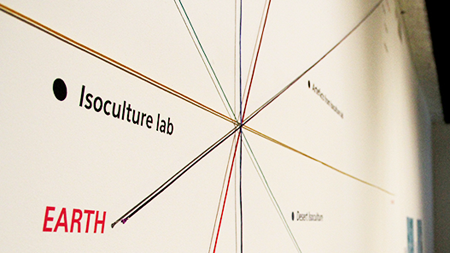
Map of Isocultures – Near to Far Future, Terrestrial to Exterrestrial
This diagram maps out the various influences that shape the design of the Isoculture according to various environmental conditions, scientific discoveries, technological advances, belief systems and human choices. The map acts to help decode the many forms that the act of isolation can take and how they shape our environment and us. Isoculture lab member |
 |
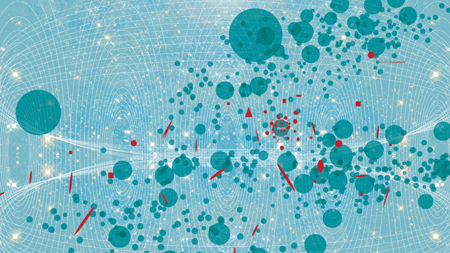
Locations of the Isoculture A map showing locations of Isocultures spanning regions found on Earth to outer space. The red markers indicate Isocultural sites and the blue markers indicate features such as stars, planets and space debris. Michael Burton and Michiko Nitta |
 |
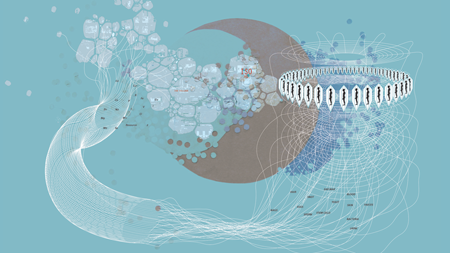
Isoculture landscape with social contract extraction chambers |
 |
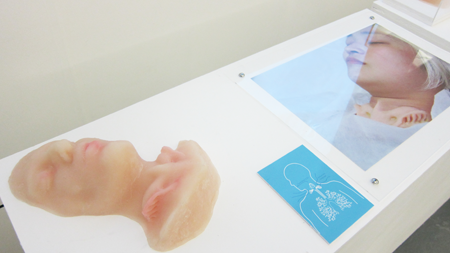
Oxygen splitting trachea enhancements – gills Within closed biosphere systems the composition of atmospheric-gases have been found to fluctuate. When we leave Earth and live in Space Isocultures and on other planets, ensuring there’s enough oxygen to sustain us will be vital. These trachea enhancements create gill-like structures to split oxygen from carbon dioxide, allowing us to survive fluctuations in atmospheric gas and low air pressure. Michael Burton and Michiko Nitta |
 |
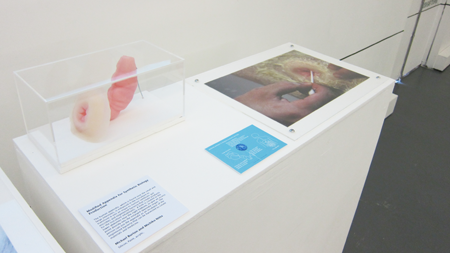
Modified Appendix for Synthetic Biology Production The human appendix, which is found near the small and large intestines, is enhanced in the Isoculture to transform this into an organ to nurture symbiotic gut microbes and engineered bacteria that create products for the Isocutlure inhabitants. A hole is created in the lower abdomen near the right hipbone, to give an access point directly into the enlarged appendix organ. The person can use the appendix as an incubator of the engineered bacteria that can be harvested to create materials and medicine. (http://en.wikipedia.org/wiki/Vermiform_appendix) |
 |
Teras, 46 Hestia, Lynpha and Maternica Showing some of the original ideas, sketched on a blackboard in the Father’s laboratory. Alan Outten |
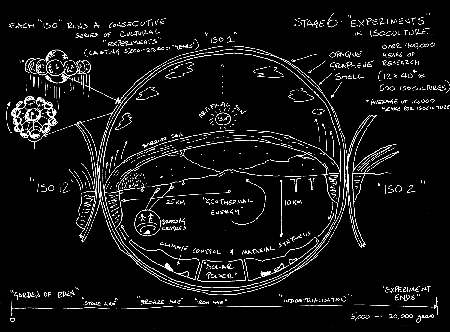 |
Will my city fit? Lynpha is big! |
 |
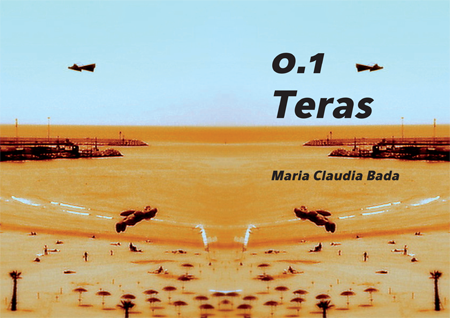
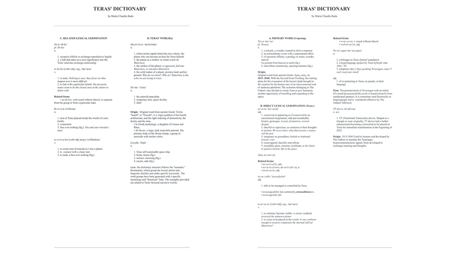
0.1. Teras The first two chapters of this yet-to-be-finished book revolve around one of the many 0.1. Teras artificial life forms sent to other planets to establish new civilizations. While travelling in Lynpha, the cold, spaceship womb of its birth, it awakes too soon, and starts questioning its humanity and its purpose. It dreams of its Fathers, and of a half-drowned Earth. Could Teras and its brothers be considered human or not? As a species, will Teras take over and replace real human beings? Teras incarnates a philosophical quest and an extreme evolution, a tantalising search for feminine energy and power to balance masculine intellectual ambitions, a cry for new worlds and knowledge, the story of a being building up its own identity in the quite emptiness of space, while the promised land, Maternica, approaches. The book also includes the Teras Dictionary. Maria Claudia Bada |
 |
Teras Dictionary This fictional dictionary describes Teras, a scared and marvellous wonder and its own universe: Teras, the last hope to continue human civilization after an escalating natural disaster. Look up to understand the taxonomy, the habits, the linguistics landscapes and metaphors generated around this newly-born creature. Learn how the Teras' clan mate, the meaning of the planet they are looking for, the origin of the asteroid which host the spaceship, and the twist of tongues that still can make you smile in Teras' world(s). Maria Claudia Bada |
 |
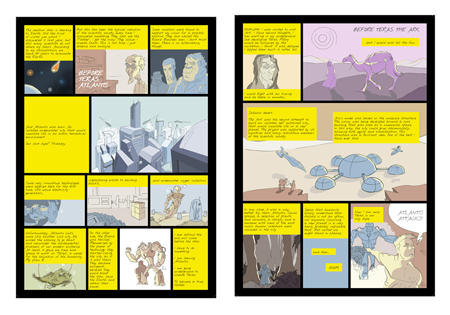
Before Teras A neutron star is approaching the Earth and humanity has 54 yeas to evacuate it. Not a long period of time if you want to prepare for colonising a new planet and live in isolation. Technology might be evolving but it is just a tool. The way to use it is up to us. Scenario based on Maria Claudia Bada’s Teras and Isoculture Team Workshops. Paris Selinas |
 |
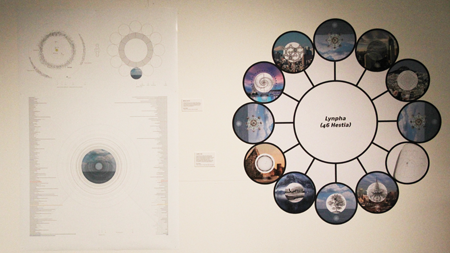
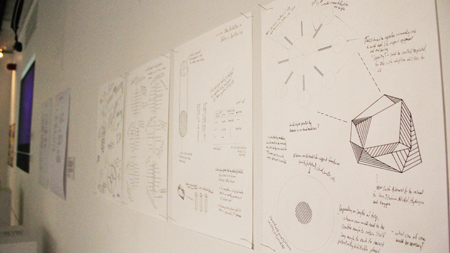
Working Drawings for the Lynpha and Other Spatial Diagrams These posters represent the working drawings of the Father, Julius, the doctor in charge of the Teras project. The drawings represent his thoughts and ideas on the Lynpha ship, with additional designs for extreme environments, both terrestrial and extraterrestrial. Ryan Neil |
 |
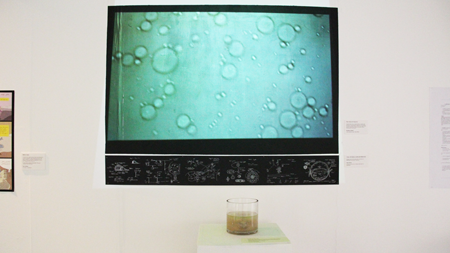
The Vision of Teras 0.1 Imagine being Teras, a creature living in a gelatin-like ecosystem. How would you visualize your surroundings through the strange substance? Will it be as clear as how humans visualize their normal surroundings? What if Teras was you in the future? Prudence Djajadi |
 |
Project supported by
 ________