
Sky documentation, 2021 - ongoing.
Sky Alive, 2025-
The Living Sky: Imagining Our Atmosphere as Alive and Intelligent
Sky Alive positions the sky as a habitat to sustain organisms and to facilitate living systems through the dynamic meteorological space of the atmosphere. Bacteria, algae, and bio-particles like spores travel in the air, creating an intelligent planetary system in the sky. In turn, this life in the sky informs the weather and our experience on the surface below.

|

|
Seen in this way, the sky is a living biome teeming with organisms like algae, bacteria, and viruses and not a lifeless space. The aerobiome is what scientists call the entire atmospheric habitat for airborne life. The life forms inhabiting this ecological zone have a powerful influence on the world below, by influencing the weather and the longer-term climate (Zimmer, 2025). We propose that these separate organisms, through their intricate connections, can collectively form something impactful, more so than through their individual entities. Inspired by James Lovelock, Lynn Margulis and Gaia Theory, we consider the atmosphere as alive with life and being transformed by life (Lovelock, 2016). We speculate this builds into an intelligent presence. This mirrors belief systems such as animism, folklore and traditional knowledge. We explored this and the non-human mind further in our project called Ecological Wisdoms (Burton Nitta, 2024) found here.
Sky documentation, fog soup on 12th February 2021
Through the project, we began a mission to interface with the sky as a living system.
As a challenge, we aim to go beyond a human-defined form of cognition and find cross-species languages to converse with the intelligence existing in the aerobiome and subsequently, the living sky. Together with other organisms and the help of advanced technology, we aim to gain an indication of the state of the sky.
To do this, we worked with fungi, plants, bacteria and atmospheric data. These living things share an amazing ability to shape the sky above, either by leaving the ground to enter the atmosphere or by emitting biological elements into the sky.
The instruments we create in the Sky Alive model and facilitate these natural processes:
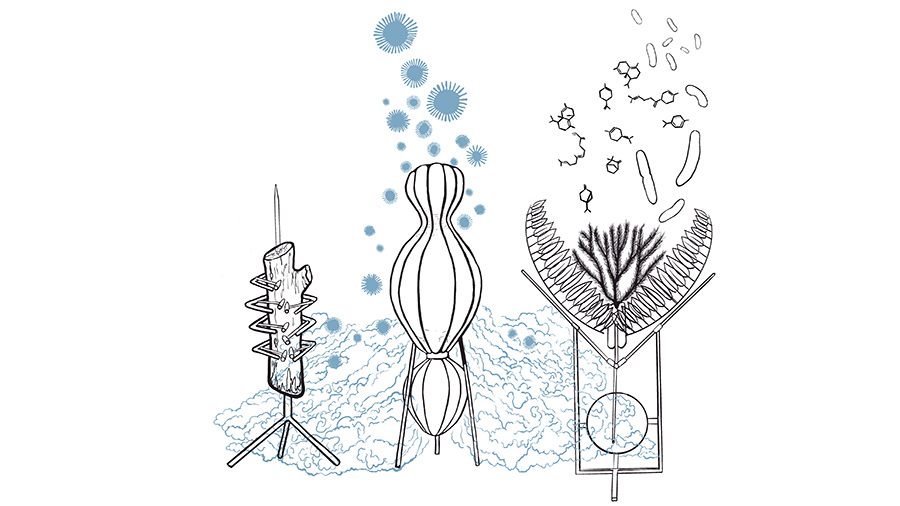
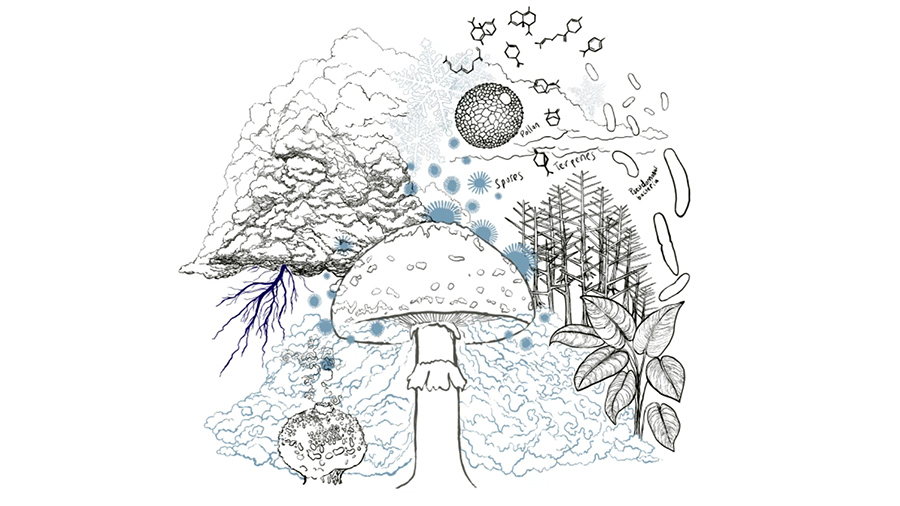
Fungal spores, plant pollen, and organic chemicals such as terpenes from pine trees rise into the atmosphere because of storms and physiological features, such as the puffball fungus. When these bio-particles are airborne, they all have the potential to seed clouds and trigger precipitation. They do this by acting as nuclei to attract moisture to them and by forming ice crystals when in the sky.
These organic elements build the diversity of lifeforms, and biomass found in the aerobiome. Their presence can have biogenic influences to create clouds. Cloud cover, in turn, reflects the sun’s rays and heat, cooling the planet. The outcome affects the weather in the near future, with climate impact in the longer term. The system crosses scales from particulate matter to planetary vastness.
We use data from various sources, including satellites, radars and sensors. These data allow us to peek beneath the surface of the sky's intelligence, translated into more-than-human languages to speak to fungi, plants, and bacteria, and to help facilitate their natural processes that influence the sky.
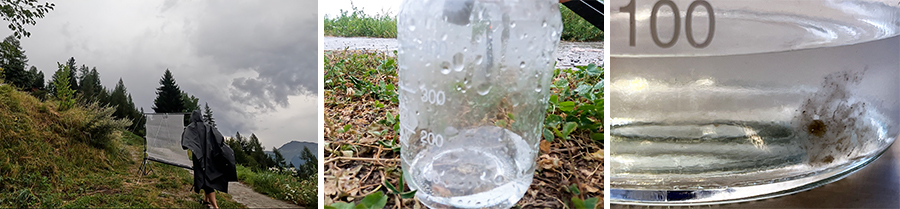
Storm rain water collected on 13th August 2025 at 1350m altitude. After the period of incubation in a sealed containter, it has presence of organisms growing inside.
So, if the aim of the work is to speak to the intelligent sky, the voice and language we use in the piece (in more-than-human ways) comprises the biological elements that interact with the aerobiome. We build instruments that engage with the organisms that produce substances or that travel to the atmosphere and trigger events beyond our immediate human perception. These organic components create and sustain the other-than-human intelligence that constructs the sky, its mind and influences weather patterns.
Sky Alive Puffball Interface, 2025. Material: mycelium, wood chip, thread, rubber, steel, electronic components. Size: app. 50 x 50 x h.170cm
Sky Alive Shiitake Interface, 2025. Material: mycelium, wood, steel, electronic components, Size: app. 40 x 40 x h.200cm
The pieces leave us with some questions:
With mass deforestation and loss of biodiversity on a global scale, are we limiting the biodiversity of the sky?
With limited amounts of biological matter in the atmosphere above us, are we also limiting the biogenic systems that influence weather and longer-term climate change?
How can we create interfaces and cultures to fathom and speak to an intelligent sky?
Sources include
Dorion Sagan and Lynn Marguils (2023, First published 1984), Gaia and Philosophy, Ignota. (link here)
Robert Macfarlane, (2025) Is a River Alive? Penguin, 1 May 2025 (link here)
Carl Zimmer (2025) A Brief and Amazing History of Our Search for Life in the Clouds. Smithsonian magazine, 25 February 2025. Available at: https://www.smithsonianmag.com/science-nature/a-brief-and-amazing-history-of-our-search-for-life-in-the-clouds-180985981/ Last accessed: 7 July 2025. (link here)
* As an Amazon Associate we earn from qualifying purchases.
Acknowledgement
Sky Alive by Burton Nitta (Michael Burton and Michiko Nitta)
With special thanks to: Hamish Steptoe (Met Office), Sound@RCA and Master of Research at Royal College of Art
Supported by
|
|
|

Take home
|
When you subscribe to our newsletter (for free), we will send you a link to unlock the full information about some of our works. |
 |
See Also


